
Peoria City Directory Holdings
Peoria city directories survive as a regional sequence, not as a neat annual shelf labeled only with the city name. The Arizona Memory city-directory collection, maintained by the State Research Library, is the main digital access point. Its genealogy guide describes almost 400 Arizona directories across 1881 through 1989. A Peoria and northwest Maricopa search returns 23 related items, including resident lists, telephone books, and address-first volumes.
| Collection | Years | Where Held | Access |
|---|---|---|---|
| Phoenix and Maricopa County regional directories | 1914 and 1915-21 examples | State Research Library | Digitized; check each volume for Peoria |
| Salisbury northwest Maricopa directory | 1949-50 | Arizona Memory | Digitized name and householder sections |
| Official Glendale-Peoria Directory | 1954 | Arizona Memory | Digitized 76.5 MB PDF |
| Mullin-Kille Glendale ConSurvey editions | 1957, 1959, 1961 | Arizona Memory | Digitized; verify Peoria coverage by book |
| Cole Greater Phoenix Criss Cross | 1962 | Arizona Memory | Address and telephone to name |
| Mountain States telephone books | 1927, 1944, 1959-62 examples | State Research Library partners | Subscriber listings; incomplete by design |
The table reflects documented examples, not a promise of continuous Peoria coverage. A regional title can include the town without naming it first. Telephone books also miss unlisted households and people without service. Search the collection catalog by place, publisher, title, and year before treating a gap as proof that a person was absent.
Peoria's 1954 Directory Milestone
The 1954 Official Glendale-Peoria Directory is the first documented volume in the sequence whose title names Peoria outright. Home Directory Service included rurals, El Mirage, and Marinette as well. The item carries call number 917.91DC G558 1954 and was digitized by FamilySearch International in 2019. That preservation date is important: an old source may have been available to remote researchers only recently.
The file is large, so a stalled viewer is not proof that the directory is unavailable. Keep the title, year, and call number. Staff can use those details to locate the volume or advise on a page request. This 1954 volume also marks the year Peoria incorporated, while earlier county and regional books reflect a town whose land and resident records were largely organized through Maricopa County.
Note: A publisher's geographic label can lag behind local growth, so inspect the index and Peoria pages before rejecting a regional volume.
Search Peoria Directories Online
The strongest online search starts with more than one form of the place name. Use Peoria, Glendale, northwest Maricopa County, Phoenix, and a known publisher in the Arizona Memory directory results. Filter the item type to City Directory. Record the full title, date, publisher, call number, and scan page for every useful hit.
- Search the surname with and without punctuation, initials, or an accent.
- Try a spouse, work name, street, or nearby household when text search fails.
- Open the alphabetic list and the street section rather than relying on one OCR hit.
- Read the page image and the book's key before copying an abbreviation.
OCR, the machine-read text behind many scans, often scrambles narrow columns and old type. The image is the evidence. A failed text result should lead to adjacent pages, another spelling, or a manual street check. FamilySearch catalog images may also require sign-in at an affiliate location even when the catalog description is public.
Read Peoria Directory Entries
The 1949-50 Salisbury book shows how much can fit in one short line. A listed name may be followed by a spouse in parentheses, a brief occupation or employer, and a residence. Marks such as h, r, and Bx can refer to a home, roomer or resident convention, and box or general-delivery mail. Meanings vary by publisher, so the volume's own key controls.
| Personal name | Head listing, initials, and spelling used in that edition |
|---|---|
| Spouse or widow note | Household tie or a clue that a spouse had died |
| Work entry | Abbreviated occupation and sometimes employer |
| Residence | House number, street, room, box, or rural delivery detail |
| Tenure mark | A publisher symbol that must be checked against the key |
- Criss-cross directory
- A book arranged by address or telephone number so a place can lead to a listed name.
- Householder index
- A street-order list of households and office occupants, often grouped by house number and intersecting streets.
- Abbreviation key
- The publisher's legend for compact marks used in entries. It should be read before any line is interpreted.
Copy the full line and a few nearby entries. Column breaks, repeated surnames, and continuation marks can change the meaning. A page number plus the title and year makes the citation reproducible. When a symbol is unclear, leave it unresolved until the key or archive staff confirms it.
Peoria Householders by Street
Salisbury's 1949-50 “Directory of Householders, Occupants of Office Buildings” is especially useful when the only clue is an old address. It orders both sides of a street by number and notes cross streets. That layout can place a household among nearby homes and businesses, even when a surname was read badly by OCR.
A listed occupant is not the same as a deed owner. The book may show a nonowner occupant, while the tax roll names the person who received the tax notice. The reverse is also true: an absentee owner can appear in land records without being listed at the home. Modern address-keyed work belongs in the Peoria street directory, while the historical city directory preserves the occupant clue for its publication year.
Note: Preserve both the printed house number and nearby cross street because later renumbering can break a search based on address alone.
Peoria Directory Years in Context
The directory run follows Peoria's change from a compact agricultural town to part of a broad metropolitan area. County records begin earlier, but the named city-directory sequence becomes clearer in the mid-twentieth century. These checkpoints help place each listing in its proper record era.
| Year | Directory or record milestone |
|---|---|
| 1914-21 | Regional Phoenix and Maricopa County books offer possible Peoria coverage. |
| 1949-50 | Salisbury publishes a northwest county directory with a street-order householder list. |
| 1954 | Home Directory Service publishes the explicitly named Glendale-Peoria volume. |
| 1957-61 | Mullin-Kille editions carry the regional sequence forward. |
| 1962 | Cole's criss-cross book supports address-to-name research. |
| 2019 | FamilySearch digitizes the 1954 directory for Arizona Memory. |
The intervals matter as much as the dates. A move between two editions can be narrowed but not dated to a precise day. Later telephone and criss-cross books also reflect subscriber and publisher choices, so their silence must be tested against deeds, census records, newspapers, or archive material.
Confirm Peoria Directory Identities
A directory entry supplies leads, not final proof of a life event. Arizona's historical genealogy system can confirm some older births and deaths with public, noncertified certificate images after the state's age thresholds. The Arizona Department of Health Services genealogy search shows the official form used for that next step.
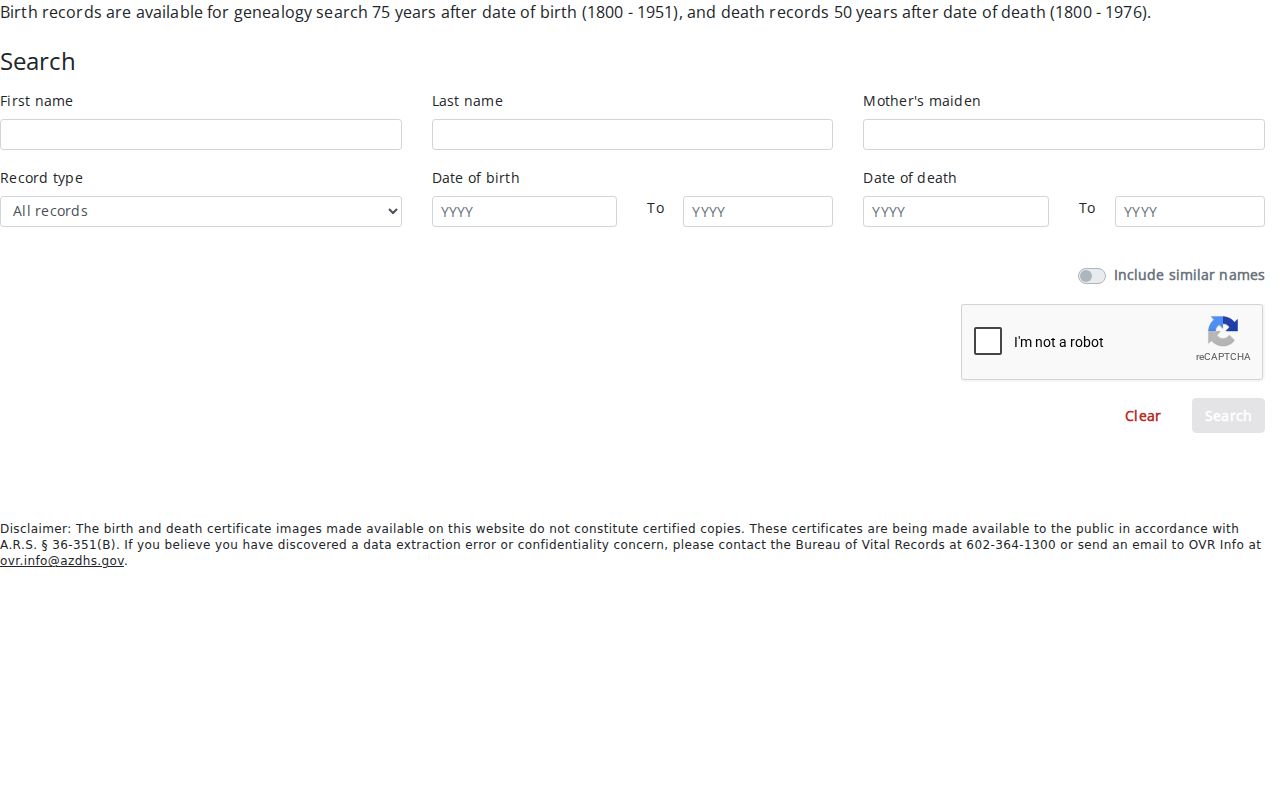
The search supports names, record type, county, dates, and family fields where indexed. Birth images open after 75 years and death images after 50 years under A.R.S. §36-351(B). A directory spouse, middle initial, or address can help separate two similar names before the genealogy result is used.
Peoria City Directory Research Desks
Not every useful Peoria directory is easy to view online. The State Research Library and Archives reading room at 1901 W Madison Street in Phoenix can work from a title, year, call number, surname, or address. Call 602-926-3870 before a visit to confirm access. Its collection page also invites questions about print years and cities beyond the scans.
The Arizona Historical Society Library and Archives accepts focused reference and reproduction inquiries. Its directory holdings can show occupation, widow or head-of-household status, and tenure marks. The Peoria Arizona Historical Society adds Old Town photographs, school material, maps, family files, and artifacts. Contact first because no fixed online shelf inventory or research hours were documented.
Newspapers and yearbooks fill different gaps. Arizona Memory reports nearly 600 yearbooks across 1903-1996 collection-wide, which may help reconnect classmates. Obituaries can identify survivors and former communities, but dates and family links should be checked against vital, census, cemetery, or probate records.
Note: Ask archive staff for one focused name, address, and date range; a precise request is more useful than a broad family biography.
Trace Peoria Families by Directory
Peoria historical directories are strongest as a sequence. One entry gives a snapshot. Several editions reveal a move, change of work, new spouse notation, or the first appearance of a widow mark. The 1950 federal census supplies a household schedule between the 1949-50 Salisbury book and the 1954 city directory.
- Begin with the alphabetic list and save the exact spelling, spouse, work, and address.
- Check the householder section for street order, nearby listings, and the publisher's tenure symbol.
- Move to the prior and next editions, including the 1954 and 1957, 1959, and 1961 books.
- Pair the 1949-50 entry with the public 1950 census, using an address or enumeration-district route if name OCR fails.
- Use the 1962 criss-cross directory, deeds, probate, obituaries, and vital images to test later clues.
Disappearance from a city directory does not by itself mean death. The person may have moved, changed names, become unlisted, or fallen outside a regional book's reach. A census household, deed, obituary, or certificate can explain the change. Keep each source's exact year and wording so a later researcher can distinguish fact from inference.